In January 2010, I planted, on the advice of my nursery-man, four little sticks. In the intervening year and a half, I’ve learned a reasonable amount about said little sticks, and I’m going to share it now. (: I am pretty sure that ‘long around September I’m going to have an addendum to this post as I try to figure out what needs whacking back. But before I launch into the lecture, let me muse for a few minutes.

I’m a native Californian. I grew up less than two hours from Knott’s Berry Farm. If you’ve ever been to Knott’s, you’ve heard the story about how Walter Knott found the last few vines in an abandoned field once owned by Rudolph Boysen, and how he turned those nearly-dead hybrid raspberry-loganberry-blackberry vines into history, fame, and delicious jam. Maybe you’ve had the chicken, biscuits, and boysenberry pie at Knott’s Berry Farm. For me, that’s a childhood memory that made a lifelong imprint. But it wasn’t until I was older — and when I started growing my own food — that I began to wonder why it was that in California, the birthplace of the boysenberry, our very own special native fruit — I couldn’t find them in the grocery store, except as jam.

So I decided I’d grow them myself. And I did.

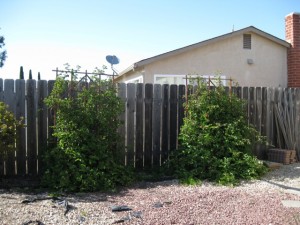
First thing I’ve learned: boysenberries love my lousy Mira Mesa clay soil, full of rocks, minerals, and under-the-surface retained water. Those four little sticks have grown into this:

North Side Boysenberries

South Side Boysenberries

Second thing I’ve learned: you really, really really don’t need four boysenberry plants for a family of two. {: Unless you love them even more than I do. I have so far in the past week made boysenberry cobbler, boysenberry pie, and have boysenberry jam cooling in jars right now.

I picked berries on Friday. I picked them again this morning. This is what I picked this morning:

Berry Harvest This Morning

That there is four and a half pounds of boysenberries. And you can see in this picture that the plants are nowhere near done.

Boysenberries growing

They do pretty much grow, flower, and fruit all at once, it seems — one gigantic harvest a year. I’ll try to make sure that I post when they are done, so that I have a record of how long they produce.

Third thing I’ve learned: bees adore boysenberries. Plant them and the bees will be all over your pretty white flowers, buzzing away happily. They like the boysenberries better than my lavender!

Fourth thing I’ve learned: unless you’re way better at trellising than me (certainly likely!), pick from the bottom up. That way you don’t step on ripe berries when you’re going for the ones in the middle and at the top.

Fifth thing I’ve learned: Just because the plant is “thornless” doesn’t mean it doesn’t have thorns at all (these have little tiny ones that are just a nuisance, rather than painful), and just because it’s thornless to begin with doesn’t mean the new canes will be thornless too. Obviously these are adapting very, very well to my yard!

Sixth thing: I know why you never see boysenberries in the grocery store. I know you might find them in the farmer’s market, but it’s 99.99% that you won’t find them in the grocery store, because a boysenberry goes from underripe to overripe in, oh, about three days. They may have cores like blackberries, but they’re soft as the raspberries they were cross-bred with. Pick a bowl of fresh ones like those in the picture above, and the almost-overripe ones will squish from the weight of the other berries. Freshly-picked perfectly ripe or just-barely-underripe boysenberries last about two days in the fridge. That’s it. You want ‘em raw, better grow ‘em yourself, or find someone who’s growing them and maybe they’ll share. (;

Seventh thing: boysenberries are terrific raw — slightly underripe, they’re much like raspberries. Closer to overripe, they’re more like blackberries. Either way, they have a honey-sweet tang all their own. But great as they are raw, they’re even better cooked. Cooking naturally mellows and melds the flavors in the berries into one cohesive taste of pure awesome — as if every point of flavor you could taste separately raw are all together at once when they’re cooked.

You can use boysenberries pretty much anywhere you’d use their cousins, but sometimes the simplest way is the best.

Pure Knott’s Nostalgia Boysenberry Jam

Makes about 11 half-pints, or 5-6 pints.

  • 4 1/2 lb. boysenberries, freshly picked, well rinsed, and cleaned of any remaining caps and leaves (have a mix of mostly ripe and some slightly under-ripe so they’ll set better)
  • 6 1/2 c. sugar (I like evaporated cane sugar, which still has a little cane flavor)
  • 2 Tbsp. lemon juice

Set up your boiling water-bath canner, jars, and lids.

Place all of the berries in a large pot and crush them gently. You can use a potato masher if you have one. I don’t, so I use a pastry cutter. You can also use the back of a big metal spoon. Just remember that boysenberry juice, like its cousins, stains like crazy. Wear an apron when you do this.

Add the sugar and the lemon juice and stir well. Bring the berries to a boil, making sure all the sugar is dissolved. Reduce the heat so that it boils gently, and cook the mixture, stirring occasionally, until it sheets off a metal spoon.

I like mine softly-gelled. So I check the big metal spoon I stir with, after I take a break from stirring for a while, before I put it back in the pot. If the jam has gelled on the spoon between now and the last time I stirred, that means it’s pretty much done. It took me about half an hour to get to a good gel.

Ladle hot jam into hot jars, wipe the rims, screw the lids on finger-tip tight, return the jars to the canner, bring to a rolling boil, and process in the boiling-water canner for 10 minutes for either pints or half-pints.

Twelve half-pints full of jam

Sweet and tangy boysenberry jam

Tags: , , , , , , , ,


One of the major challenges of smoking pork is that the well-known applications tend to take time. In the case of ribs or shoulder, it’s time on the grill; bacon, it’s a week in a brine.

So I share an approach which I successfully created yesterday. Because of the title, you’ve probably already guessed that I smoked pork chops. They don’t take nearly as long. (About an hour and a half for half-pound chops.)

So here’s the run-down:

  • Meat: six half-pound pork chops (about an inch thick). Organic, from Jimbo’s, you know the drill.
  • Rub: The Original Texas BBQ Rub (from TexasBBQRub.com). They don’t tell you exactly what’s in it, but will admit to sugar, cane syrup, salt, red pepper, black pepper, and garlic. Replace the sugar and cane syrup with brown sugar, and that’s a pretty good rub on its own.
  • Wood: Peach. (Like the rub, this is from the in-laws’ Christmas gift.)
  • Mist: Peach Lemonade. (I used Santa Cruz Organic’s.)
  • Cooking Temperature: 250 degrees (Fahrenheit).
  • Temperature Target: 140 degrees, then let rest for about five minutes. (As per the most recent USDA guidelines.) As mentioned before, the smoking should take around an hour and a half.

Prep is pretty simple: before you start smoking your peach chips, dust the pork with some of the rub to let it marinate a bit before you put it on the grill. Every time I turned the pork, I misted the top side of the chops with the lemonade, flipped the chops (remembering to rotate the closer chops away from the heat), and then dusted the other side with the rub.

Those of you who’ve read Mike Mills’ book will recognize the technique (only Mills builds around apple). The results are very similar; peach wood seems to add a very similar flavor to the smoke, and the peach lemonade sprayed well. (I avoided peach nectar because it’s thicker, and I wasn’t willing to risk my spray bottle to it.)

Serves six.

(Props to Better Homes and Gardens All-Time Favorite Barbecue Recipes, 1977 edition, for suggesting smoking pork chops; and Peace, Love, and Barbecue for the technique.)

Tags:


Everyone should be able to make basic spaghetti sauce. Everyone. And there’s no excuse for it to not be fabulous, when it’s really easy to do. This is what I do; feel free to play with it, ’cause it takes just fine to adaptation.

Red Sauce

  • 2 32-oz cans crushed tomatoes
  • 2 6-oz cans tomato paste
  • olive oil
  • the largest onion you can get your hands on (use two if they’re small)
  • 5 cloves garlic, minced
  • red wine
  • 2-oz package dried mushrooms (I use porcini when I can get them, but any kind works), or you can chop up some fresh mushrooms instead
  • 1 1/2 Tbsp. basil
  • 1 1/2 tsp. fennel seed (whole, not ground), oregano, thyme, and parsley
  • 1 tsp. rosemary
  • 1/2 tsp. hot red pepper
  • optional: sausages

Rehydrate the mushrooms in 2 c. hot water for about 15-20 minutes. Drain, reserving the soaking water, and chop the mushrooms.

Chop up the onion and saute in a large pot with olive oil. When the onions are tender, add the garlic. When it’s fragrant, add the mushrooms, crushed tomatoes, tomato paste, a generous splash of red wine, the mushroom soaking liquid, and all the spices (I should note that I never really measure these; I measured the last time I made this just especially for you folks). Stir well and bring to a simmer.

If you’re adding sausages, add them now. My family always cut them in half, so I do too. You could saute them ahead of time, but I never bother; they’re just as good this way.

Simmer the pasta sauce for at least two hours. Add water if it gets too thick. Stir occasionally. Enjoy immensely.

Tags: , , , ,


Boysenberries, blueberries, strawberries

Tags: , , , , ,


No pictures. I know, I know. I ATE IT ALL, okay? ^_^

This is a great thing to do with leftover ricotta, which I often have, and then dither on what I should do with it. No dithering here! If you want to be luxurious, add a slice of prosciutto to each sandwich, or leftover sliced cooked sausage.

By the way, since I have your rapt attention: it’s one PANINO, two or more PANINI. Not that any of the fast-food places seem to know this or care. (;

Roasted Tomato Panini

Serves 4

  • 1 sourdough baguette, sliced into four sections, then sliced in half horizontally (so you get four long sandwich rolls)
  • ricotta (a couple tablespoons per sandwich, or more, if you don’t mind your sandwich being gooshy)
  • 8 Roma tomatoes, stems removed and each sliced lengthwise in half
  • mixed lettuces
  • olive oil, balsamic vinegar, salt, pepper, basil, oregano

Preheat the oven to 400°. Place the Roma tomato slices on a baking sheet. Drizzle with olive oil, sprinkle with salt, pepper, basil, and oregano, and pop in the oven to roast until wrinkled, slightly chewy, and smelling wonderful, somewhere between 40-50 minutes. You can do this step ahead and just pull the tomatoes out of the fridge whenever you need to make sandwiches. They’ll keep for a few days.

Pull out some of the soft inside of the bread. You can save that for making breadcrumbs or croutons or just eat it (which I will admit that I do, sometimes). Toast the bread if you want, or not. It’s good either way. Spread the bread thickly with ricotta, sprinkle with salt and pepper, and top with roasted tomatoes.

Toss the mixed lettuces with a little balsamic vinegar and olive oil and place on top of the tomatoes, top with the other half of the bread, and serve immediately.

Tags: , , , ,


If you don’t do a lot of medieval cuisine, you’ve probably never heard of poudre fort and poudre douce — literally, strong powder and sweet powder. I was first introduced to the concept when I was doing SCA regularly, via a nifty little pair of books called Take A Thousand Eggs or More, by Cindy Renfrow. They’re both spice blends, one spicy and one sweet, and there’s no standard recipe for either of them. So I’m going to share mine with you.

Now, you’re probably thinking — I don’t cook medieval cuisine, what’ll I do with these blends? Actually, they’re terrifically flexible. I use my poudre douce blend for French toast, cookies, pumpkin pie, the spices in my jam, you name it, if it’s sweet, it will go well. Poudre fort is great with pork, beef, and chicken, especially in stews and slow cooking. Of course, if you want some heat in your sweet dishes, you can use poudre fort there too.

Poudre Douce
Inspired by a production of The Knight of the Burning Pestle, wherein Master Merrythought sings,”Nutmegs and ginger, cinnamon and cloves, and that gave me this jolly red nose.” You’ll note it doesn’t scan well. Most of Master Merrythought’s songs don’t. The general consensus amongst the cast was that he was supposed to be singing poorly because he was drunk, but that’s kind of a far reach for a modern audience who doesn’t know the songs. In our production, it was switched to “cinnamon and ginger, nutmeg and cloves” … and it has been stuck in my head ever since.

  • 5 parts ground cinnamon
  • 3 parts ground ginger
  • 2 parts ground nutmeg
  • 1 part ground cloves

Combine all ingredients, mix well, and store in an airtight container.

Poudre Fort

I heavily adapted this blend from War Fare, by Bonny Feinberg and Marian Walke, which was recommended to me by a friend. “You remember Old Marian? She wrote a cookbook …” Well, that was that, I had to get a copy. (And mmm, the recipes in it are delicious.)

  • 4 parts poudre douce
  • 2 parts ground cubebs
  • 1 part ground peppercorns

Combine all ingredients, mix well, and store in an airtight container.

Enjoy!

Tags: , ,